Landing takes up only a few minutes of a flight, but it asks more of the crew than any other part. The aircraft has to arrive at one exact place, at the right height and speed, close to the ground, with little time to fix a mistake. Here is why that is so hard, and why pilots are trained to walk away from a landing that does not look right.
What the numbers say
First, some perspective: flying is very safe. Boeing counted 72 fatal accidents among large commercial jets worldwide from 2004 through 2013, out of about 219.5 million departures.
What stands out is when those rare accidents happened. Sixteen were on final approach and 18 during landing, which makes 47 percent of the total. A later Boeing summary, covering 2007 through 2016, put each of those phases at 24 percent. Yet together they make up only about 5 percent of an average flight.
Everything has to come together at once
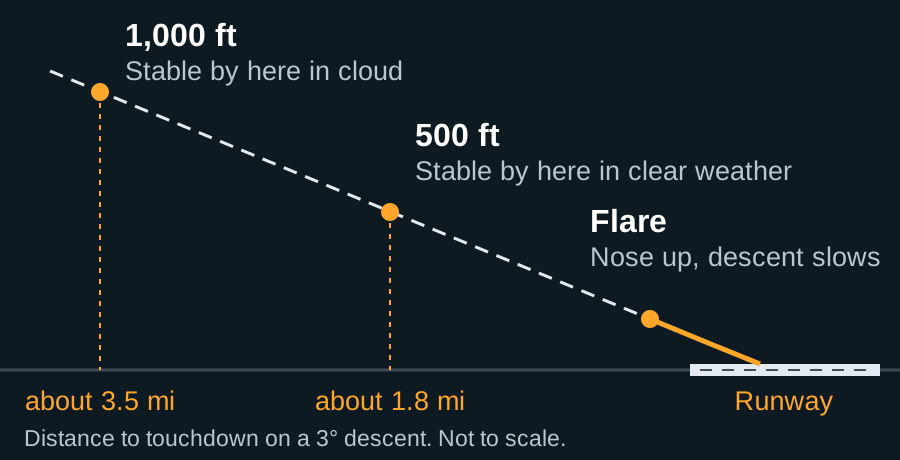
A typical airliner comes down a slope of about 3 degrees, losing several hundred feet every minute while still moving at around 150 mph. During that descent the crew lowers the landing gear, sets the flaps, slows the aircraft, finishes the checklists and follows instructions from the tower.
Takeoff is demanding too, but it starts from a standstill at a known spot, and every second takes the aircraft further from the ground. A landing works the other way: height and speed run out together, and the ground gets closer the whole time.
That is why crews use checkpoints called stabilized approach gates. By a set height, the aircraft should be on the correct path and at the correct speed, with the landing gear and flaps set and the checklists done.
The flare: the last few seconds
If an aircraft flew that slope all the way down, it would hit the runway far too hard. So just above the ground the pilot raises the nose. This move is called the flare. It slows the descent and sets up a softer touchdown.
Timing is everything. Flare too late and the landing is hard. Hold it too long and the aircraft floats down the runway, using up pavement it may need for stopping.
Crosswinds make it harder
Runways do not turn to face the wind. When the wind blows from the side, the aircraft has to keep moving straight along the centerline while the air pushes it sideways. Pilots have two main answers:
- Crab: point the nose partly into the wind, so the aircraft travels down the runway line while facing slightly away from it.
- Sideslip: lower the wing facing the wind and use opposite rudder to keep the nose straight. The wheels on that side touch down first.
Many landings use a mix of the two. Either way, the pilot has to get the wheels and the runway lined up at the moment of touchdown, while the wind keeps changing.
Why a go-around is a good thing
If you have ever been on a flight that climbed away just before landing, you have been through a go-around. It can feel dramatic, but it is not an emergency. The crew has simply stopped the landing and is setting up to try again. The reason could be an approach that is not stable, traffic on the runway, a sudden change in the wind or an instruction from the tower.
The hard part is often making the decision. Flight Safety Foundation research found that about 3.5 to 4 percent of approaches were unstable, and that crews carried on to land in 95 to 97 percent of those cases. That is why safety experts keep telling pilots that a go-around is a normal outcome and not a failure.
Try it yourself
The best way to appreciate all this is to have a go. In Tower, our own air traffic control game, you sequence arrivals over real-looking airports, and a blocked runway means a go-around. Approach gives you the same job on a dark radar screen. To fly the landing yourself, try the Lander Game, Hero on The Hudson or anything else in our landing games.
Still curious? See if you can name the airport from its runways, or read about the 8 most terrifying airport runways.
Sources
- Flight Safety Foundation on Boeing’s 2004 to 2013 figures. They cover commercial jets above 60,000 lb and leave out Soviet-built aircraft.
- AirlineRatings on Boeing’s 2007 to 2016 figures and the 5 percent share of flight time.
- Aviation Week on stabilized approaches and how often crews continue.
- Wikipedia on the flare, crosswind landings and the go-around.